CPYU Parent Prompts are a regularly released resource to spark biblically-centered conversations with your kids about the issues they face in today’s youth culture.
Download the Parent Prompt here.
By: Kyle Fulks, CPYU Research Fellow and Assistant Pastor at Hope Community Church, Gilbertsville, PA
As the primary discipler, God has given each parent the gift and responsibility of guiding, nurturing, and protecting their child. Due to God’s good design, parents have a tremendous impact on their child’s faith.
Learning often occurs in two ways. By being explicitly taught what to believe, and by information being caught without realizing it. Adolescence is an important time period in a person’s life as identity, purpose, and values form and take root. During this stage of growth, parents need to pursue their children by explicitly teaching the way and the truth of Jesus Christ so they are each able to live out God’s good design for humanity.
(W)ORLD: What is Happening?
- Our world is full of noise. If you’re reading this article on an electronic device, there is a high probability you will get a notification or two (or eight) before you finish. This is the reality of the cultural moment in which we live. With this noise comes information, ideas, and beliefs. All people, your child included, are being taught to think about and believe a variety of viewpoints as they are surrounded by seemingly endless noise and information.
- The question is not if your child is being taught, but who is teaching your child. This is not meant to bring fear but to shed light on the significance of the situation and opportunity before you. As the old adage goes – if you fail to plan, you plan to fail.
- There are numerous sources of information; each with the potential to explicitly teach your child. These include his or her parent(s), family, church, friends, and teachers. While people play a major role, technology also allows more opportunity to interact with different ways of thinking.
- While there is much to be thankful for with technology there is also an abundance of dangers. The fact that the word “doomscrolling” has entered our vernacular highlights our problematic cultural moment. According to a study by the American Academy of Child and Adolescent Psychiatry, “On average, children age 8-18 in the United States spend 7 1/2 hours a day watching or using screens.” Whether through social media, influencers, shows, or music, endless amounts of life-shaping and formative information is consumed.
(W)ORD: What does god’s word say?
From the beginning, God set up the family unit to nurture the flourishing of faith in future generations. It is God’s good design that parents are to intentionally teach their children about God and how to faithfully follow Him. Deuteronomy 6:4-7 clearly describes that a home committed to God is a home that diligently teaches children how to live faithfully before God and others. “Hear, O Israel: The Lord our God, the Lord is one. You shall love the Lord your God with all your heart and with all your soul and with all your might. And these words that I command you today shall be on your heart. You shall teach them diligently to your children, and shall talk of them when you sit in your house, and when you walk by the way, and when you lie down, and when you rise.”
Psalm 145:4-5 states “One generation shall commend your works to another, and shall declare your mighty acts. On the glorious splendor of your majesty, and on your wondrous works, I will meditate.”
The Apostle Paul also exhorts fathers in his letter to the Ephesians (6:4) when he writes “Fathers, do not provoke your children to anger, but bring them up in the discipline and instruction of the Lord.”
Throughout the bible God reveals to and instructs His people to take seriously their responsibility to faithfully proclaim what is good, true, and beautiful to future generations. We must purposefully instruct and pass on biblical knowledge and wisdom so children learn about God’s plan, will, and way for all things. Some examples are saving faith, treasuring God above all, trusting God’s character, finding identity as God’s son or daughter, and developing the ability to discern God’s good, acceptable, and perfect will. Equipping to discern between what is true and false, and more importantly between what is true and an almost truth, is essential in a world full of noise and information.
(W)ALK: Conversation Starts and Questions:
As the primary influence and discipler in a child’s life, parents must be purposeful in bringing up their children in the instruction of the Lord. Deuteronomy 6 reveals parents are to set specific time for teaching and learning while taking advantage of opportunities that arise organically. Both are needed: time set aside as a regular rhythm, and teachable moments that come about driving home from sports practice.
For many parents this can seem overwhelming. Where do I start? What do I read? My kids are not interested. Start by setting a goal for you and your family. Then take one step at a time towards that goal. A parent can’t do everything (and certainly can’t start with everything), but a parent needs to do something. Purposeful actions added up over time produce beautiful fruit. Intentional times of spiritual formation at home do not have to be a huge production. Every family and child is different, so unique implementation is needed.
There are numerous resources and ways to do this with your family. But in general, while the younger you start the better, it is never too late to start. The earlier some of these ideas are implemented, there may be a higher chance it becomes normalized in your household.
Whether scheduled or spontaneous, developing and encouraging conversation and the freedom to ask questions is important. When you see something that is not aligned with the Christian faith, talk about it. Your child probably saw it, too! Maybe a movie you are watching has a worldview contrary to Christianity. Ask some questions about what they thought about it. The goal is not to preach to your child every second, but to be conversational and instructive.
A few ideas you can start implementing:
- Write down one thing this month you would like to implement. Start where you are, not where you want to be.
- Ask other families to pursue similar things together.
- Prayer: Before praying together at a meal, have everyone share one thing they are specifically thankful for. Pause for prayer as your child heads to school or before bed.
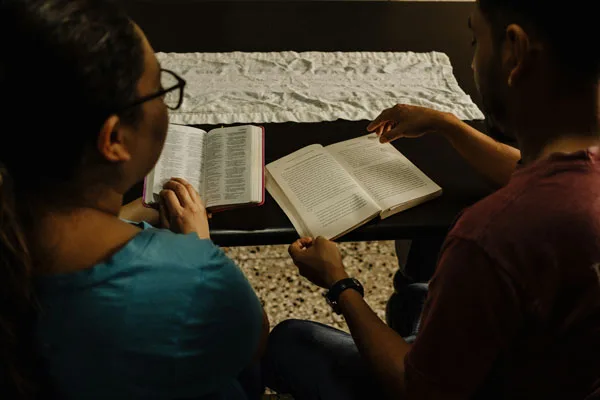
- Read or Study: Set a weekly time to read and discuss a bible passage or chapter. Make it a point to discuss passage and sermon after church.
- Set non negotiables: Explain why you have made these choices in an age appropriate way. Why do you prioritize gathering with your church family? What boundaries do you have with technology? Are there lifestyle choices that all your child’s peers are making that you are seeking to avoid?
- Specific topics: Set aside specific time to talk through topics such as sexuality, pornography, vaping, abortion, dating, or healthy technology habits. Teach how to wisely steward our time, talent, and treasure. If your high school student gets a job, help them think through how they spend, save and give generously with their new income.
- Use a study plan or resource surrounding a church holiday like Advent/Christmas or Easter.
- Involve your child in choosing what to learn or study. Are there any specific topics that interest them?
“Great is the Lord, and greatly to be praised, and his greatness is unsearchable. One generation shall commend your works to another, and shall declare your mighty acts.”
Psalm 145:3-4
Download the Parent Prompt here.
