
Does it make your head spin like it does mine? Mine’s been spinning since first learning about and then fiddling around a little bit with AI.
Initially, I took the bait to dabble with the unpaid version of Songer, which made for some good laughs during last summer’s family vacation. Nano Banana has made it easy to indulge the creativity of generating some equally humorous images. But then my over-a-decade-long admonition to be a “wader” rather than a “diver” into all things new technology kicks in, reminding me to do as I say. That’s led to an ongoing internal debate over the potential and already-realized blessings and curses of a technology that’s here to stay and changing every day. The debate’s not only internal. We bat it around quite a bit in our CPYU office.
As with all things youth culture, our approach is to put AI under the light of Scripture and theology, working to figure out how to navigate AI with care and concern, all to the glory of God. Ultimately, we are wondering how to use AI to advance our human flourishing, rather than undermining God’s plan for what it means to be human. Practically speaking, we want to prevent addiction, dependence, and the derailing of our Christian faith. And truth be told, all of us in ministry need to be treading carefully and obediently onto this mind-boggling new digital frontier.
Having been a youth worker myself and one who’s been embedded in the world of youth ministry for almost five decades, I know two things that generally run true in our tribe. . .
First, our youthful bent and time spent living in the soup of today’s youth culture with our kids means that we look for and find new technologies faster than most. Just look at the history of youth group meetings and our meeting spaces. Let’s admit it now, we are drawn to the latest and greatest. . . and if the budget allows, we grab it. Quick integration.
Second, we tend to trend young, even those of us who have been in the game for a long time. Because of that, we have a youthful eagerness that leads us to move quickly and perhaps without much forethought into the world of new technologies. In other words, our youthful enthusiasm leads us to bypass the process of cautious consideration. We may not be thinking critically and Christianly as we should.
I’ve been reading quite a bit about AI and new technologies, all in an effort to remedy the liabilities that come with our youthful bent. Recently I finished Sean O’Callaghan and Paul Hoffman’s AI Shepherds and Electric Sheep: Leading and Teaching in the Age of Artificial Intelligence. If you haven’t yet begun to think critically and Christianly about AI and the implications for your personal life and ministry, this book offers a great start. And, if you’ve been on the figuring-out-AI-journey for some time, it’s an equally valuable read.
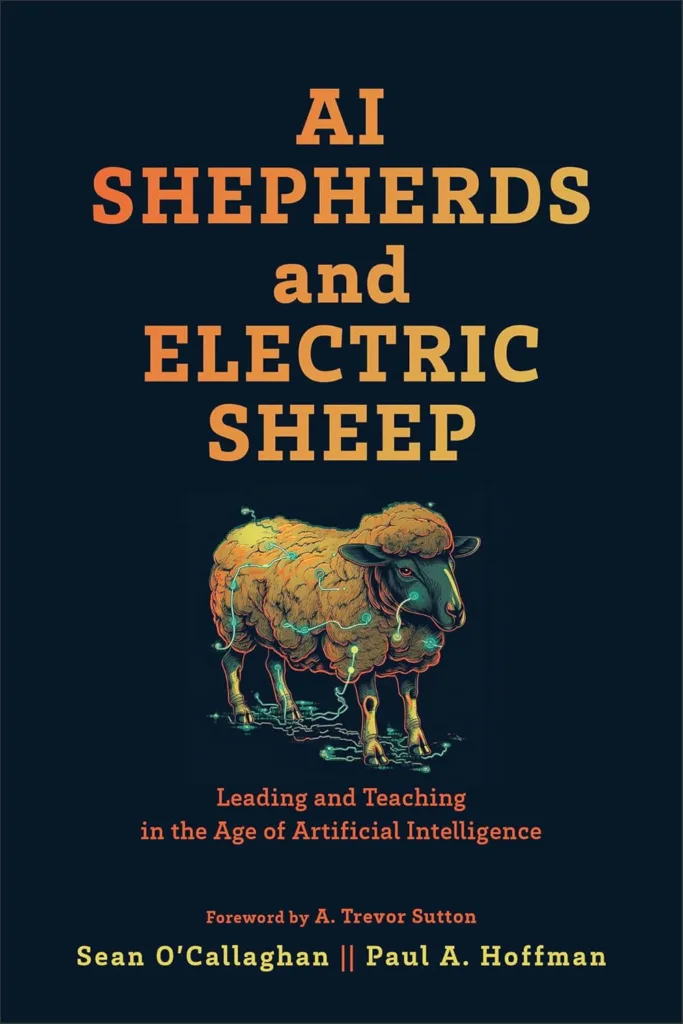
I love these words from A. Trevor Sutton in his Foreword for AI Shepherds and Electric Sheep: “For AI to flourish, it needs the unique resources of the Christian faith and well-equipped shepherds prepared to lead God’s flock in this electric age. It is here – and only here – that AI will find a true and enduring narrative, practices that promote focus and flourishing, and the hope that comes in and through Jesus Christ. As long as the Christian faith is absent from conversations about AI, it will always be missing something. The future is coming, and it needs the hope of Jesus and his image bearers in it.”
We can’t diminish the foundational work that makes up the beginning and middle of the book. It’s so, so helpful. All of our behaviors need to flow out of proper belief, and O’Callaghan and Hoffman build the foundations so well. . . all grounded in the proper kind of theology that informs every nook-and-cranny of life. But for the sake of space and in an effort to whet your appetite to read the entire book, I thought I would jump to the practical suggestions they put forward in the chapter titled, “How Should Ministry Leaders Approach AI?” Perhaps sharing these will save you from the kind of well-intentioned yet knee-jerk adoption of AI tools that in the end are counter-productive in our lives, our ministries, and the lives of our students. . . practices that undermine the kind of spiritual growth and kingdom advancement that we hope for, pray for, and are called to. So here goes . . .
Do not use AI to write or deliver an entire sermon or Bible study lesson. “What’s the problem?” they ask. “It is reductionistic to treat preaching and teaching as simply content distribution. In reality, preaching (and in some respects teaching) involves a sacred monlogue occuring among God’s image bearers – including elements of dialogue, as the congregation gives verbal and non-verbal feedback to the speaker, who then responds and adjusts.” They remind us of something we’ve lost in a world of downloadable talks and lessons. . . which will only intensify with the growth and adoption of AI: that our preaching and teaching “is linked to a dynamic chain of custody, bringing about a supernatural transmission and involving the complex interplay between Holy Spirit, the Scriptures, the communicator, and the audience.” As I’ve said so many times before, youth workers need to teach and preach out of a deep well that they’ve painstakenly filled with their own study. At the very least, using someone else’s material is in many ways passionless. Some of us have been around long enough to see this play out in ourselves and in others. . . and in today’s world, everything is there for the taking if we want to avoid time in our own study. We can and must do better than this!
Do not use AI as a substitute for interpersonal counseling. “It is vital to remember that God created humans to connect with one another and that effective counseling is based on several intangibles that machines cannot possess. These include emotional intelligence, intuition, accumulated wisdom, and experience.”
Do not use AI to write whole worship songs or plan entire worship services. “In Scripture, worship is something done for God and by humans. . . . It is composed and executed by God’s image bearers, who are uniquely fashioned for this very task.”
Cautiously use AI to generate, research, and edit content for sermons and Bible studies. The authors rely on Greg Hollifield and his advice to “treat AI as a collaborater”, using it to brainstorm topics and passages, provide researched answers, compile a list of commentaries, gather online sermons based on a chosen text, offer a different perspective, reimagine what you have developed, polish your outline, suggest illustrations and applications, and translate your work into other languages.” Truth be told, I’m personally hesitant with a few of these for the simple reason that we can become over-reliant over time. I would rather hunker down adn do the hard work on my own.
Cautiously use AI to create job postings and volunteer descriptions. Again, use AI as an aid in composing drafts.
Consider using AI to produce content for social media, websites, and instruction. The authors remind us that AI should be an editor, not a creator. As divine image-bearers, we have been given agency, and we live out the image of God through our “imaginative and productive talents God has bestowed on humans.”
Consider using AI for human capital management, especially managing volunteers. We’re talking here about both data management and the stewarding of human capital in our ministries.
Consider using AI to expand God’s mission through language translation. I love this!
So. . . tread slowly and carefully. . . counter-culturally. . . critically and Christianly. . . onto the AI frontier. . . and read this book!
Stay tuned as we endeavor at CPYU to think with you about AI, offering guidance and direction.
